

The Renevlyn Development Initiative (RDI), in collaboration with Foodjustice, on Thursday, January 15, 2026, offered training to Nigerian journalists in Lagos, on effective reporting of the Planetary Health Diet, to drive policy action.
Speaking at the training, the Executive Director of RDI, Mr. Philip Jakpor, noted that the media plays a strategic role in shaping public understanding and influencing policymakers on health, food systems and environmental sustainability.
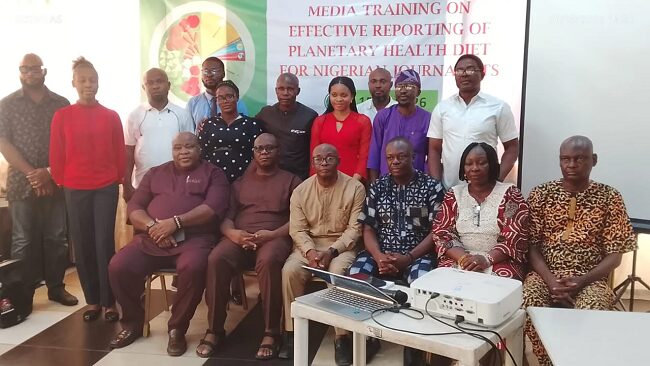
Jakpor described the Planetary Health Diet as a science-backed dietary pattern that promotes human health, while protecting the environment, with emphasis on plant-based foods and reduced intake of red meat and processed foods.
He said that, in spite of its vast arable land, Africa remained marginal in global adoption of the dietary model, even as the continent grapples with malnutrition and rising non-communicable diseases.
According to him, non-communicable diseases account for about 30 per cent of annual deaths in Nigeria, with over 617,000 deaths recorded in 2020, and many being premature
He said that lifestyle changes, urbanisation and poor diets had driven the rise of illnesses previously uncommon in Africa.
He urged the need for a science-based solution.
Jakpor said that the training featured experts from Nigeria, Ghana, Mexico and Italy, who shared experiences on integrating planetary health diet principles, into agriculture, education and school feeding systems.
Speaking on reporting considerations, Mr. Tope Oluwaleye, a veteran journalist, urged journalists to present the diet as flexible and adaptable to local cultures, rather than as a strict exclusion of animal products.
He said that reports should highlight both health benefits, including reduced risk of diabetes, and environmental gains such as lower emissions and biodiversity protection.
Oluwaleye also urged journalists to address criticisms transparently, including possible nutritional gaps, while promoting balanced and high-quality diets.
In a session on policy integration, Dr Chioma Okonkwo, another resource person, said that the diet could be mainstreamed into existing Lagos State public health and nutrition frameworks, without creating new policies.
She identified public food procurement and primary healthcare services as practical entry points for integrating healthier and more sustainable diet guidance.
Okonkwo said that journalists should track policy signals such as budget allocations, institutional responsibilities and monitoring indicators to distinguish intent from implementation.
The training aimed at equipping journalists to produce in-depth reports capable of driving accountability and accelerating adoption of healthier, sustainable diets.
By Fabian Ekeruche