

The Christmas Eve fire outbreak at a 25-storey building on Lagos Island has once again thrust Nigeria’s emergency response system into the public spotlight.
It has also renewed concerns over the country’s preparedness for large-scale disasters.
According to the Lagos State Emergency Management Agency (LASEMA), the inferno at the Great Nigeria Insurance building claimed three lives and left at least 12 others injured, while goods worth millions of naira were destroyed.
Disturbingly, the bodies of the deceased were only recovered from the rubble four days after the incident; an outcome that has fuelled public criticism.
This is not an isolated case.
Previous fire incidents, including the blaze that displaced traders at the Tejuosho Market in Yaba, Lagos, were similarly met with complaints from victims over delayed and poorly coordinated responses.
Beyond fire outbreaks, other emergency situations have also exposed systemic weaknesses.
On Dec. 29, a tragic road crash involving British-Nigerian boxer Anthony Joshua at the Sagamu end of the Lagos–Ibadan Expressway claimed the lives of two of his friends.
Although dissimilar in nature, the handling of the aftermath attracted widespread criticism, especially over the timeliness and efficiency of emergency services.
Against this backdrop, experts describe Nigeria’s emergency response landscape in 2025 as one of mixed fortunes.
On the one hand, it has been marked by catastrophic failures; on the other, by the gradual emergence of technology-driven solutions.
Albeit the existence of a formal institutional framework under the National Emergency Management Agency (NEMA), analysts argue that the system remains dangerously reactive rather than proactive.
Dr Adeleke Pitan, an emergency response expert, notes that the current approach often waits for disasters to occur before mobilising resources, instead of using predictive data to pre-position assets in high-risk locations.
He emphasised that the first 60 minutes following a traumatic incident; the so-called ‘Golden Hour’, is critical to survival.
However, in Nigeria, this window is frequently lost to traffic congestion, weak communication systems and the absence of decentralised response units.
The devastating floods in Mokwa, Niger State, in May 2025 underscore this challenge.
The disaster left 159 people dead and nearly 100 others missing.
NEMA said it had issued early warnings ahead of the flooding, working in collaboration with the Nigerian Meteorological Agency (NiMet) and the Nigeria Hydrological Services Agency (NIHSA).
“In collaboration with NiMet and NIHSA, NEMA’s early warning systems involved disseminating seasonal climate predictions and real-time flood alerts via radio, television, social media and town criers,” the agency said.
Nevertheless, analysts such as Richard Davies argue that early warnings alone are insufficient when local emergency infrastructure lacks the capacity to respond.
Citing a joint assessment by the International Organisation for Migration (IOM), NEMA and partners, Davies said 3,018 individuals across 503 households were directly affected by the Mokwa floods.
“Of these, 1,590 people were displaced, while 1,428 remained in damaged or flooded homes. At least 265 houses were destroyed and a further 20 were severely damaged,” he said.
Beyond weak local capacity, limited resources remain a major constraint for emergency responders.
A recent publication by Emergency Response Africa (ERA) revealed that, as of early 2025, Lagos State reportedly had only one functional heavy-duty crane dedicated to major rescue operations.
“Many critical tools such as cranes, earthmovers and fire trucks have exceeded their operational lifespan,” the report stated.
“As of 2024, the state reportedly had just one functional crane for major rescue operations, which is grossly inadequate for a megacity of over 20 million people.
“Compounding the problem, spare parts for these ageing machines are increasingly difficult to source, as some models are no longer in production.
“This forces LASEMA to depend on private contractors for critical equipment; an option that is both costly and unreliable,” ERA added.
The healthcare technology firm also identified low public awareness, shortages of skilled emergency personnel and fragmented coordination among response agencies as persistent challenges.
Experts argue that effective emergency management must begin long before disasters occur, through strict regulatory enforcement.
They stress that agencies such as state ministries of physical planning must be fully integrated into the emergency response chain to prevent avoidable incidents.
They cite the Ojodu-Berger building collapse of April 2025, which left one person dead and 13 others trapped.
Investigations later revealed that the structure had undergone unauthorised modifications.
More broadly, analysts observe that disaster management in Nigeria is frequently hampered by weak coordination among federal, state and local institutions.
To address this, they advocate the creation of a unified digital dashboard to enable real-time inter-agency coordination, alongside the full implementation of a functional national ‘112’ emergency helpline.
Public–private partnerships are also gaining attention.
For instance, collaborations with firms such as ERA deploy GPS-enabled routing systems to dispatch the nearest available ambulance, helping to bypass referral delays that often prove fatal.
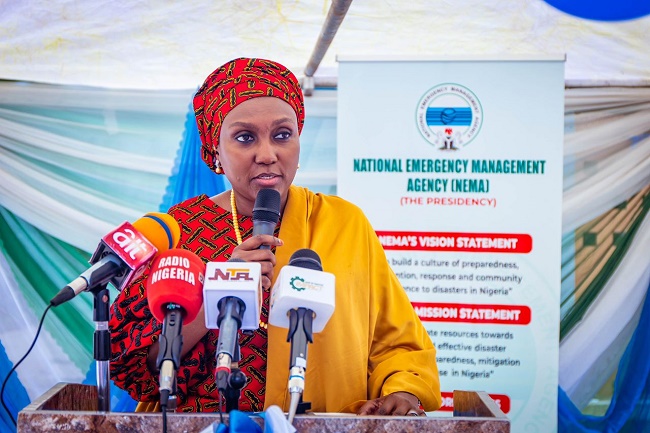
NEMA’s Director-General, Mrs. Zubaida Umar, has consistently called for a fundamental shift in thinking; from reaction to prediction.
“Emergency management can no longer be reactive; it must be predictive, preventive and participatory.
“Our citizens should not encounter us only when disaster strikes. They should see us every day, building safer communities, raising awareness and ensuring preparedness,” she said.
Experts say this shift must be backed by investment in physical mitigation measures such as dams, embankments and improved drainage systems, rather than allocating the bulk of resources to post-disaster relief.
Similarly, long-term recovery efforts should move beyond the distribution of relief materials to rebuilding climate-resilient housing and restoring farmlands after floods.
As part of a broader overhaul, analysts also argue that Nigeria must abandon the practice of waiting for emergency fund approvals after disasters occur.
Instead, they recommend the establishment of dedicated, pre-approved state-level emergency funds that can be accessed immediately once a disaster is declared.
This, they say, would require states to halt the diversion of ecological funds and ensure that every local government area maintains a trained Community-Based First Responder network.
Finally, experts call for a comprehensive review of the National Disaster Response Plan to reflect modern emergency response strategies and clearly define the roles and call-out procedures of all stakeholders.
By Kayode Adebiyi, News Agency of Nigeria (NAN)