

Biodiversity loss continues to accelerate, driven by multiple interconnected pressures including unsustainable use, illegal trade, habitat degradation and the broader impacts of environmental change.
It was within this evolving landscape that the seventh session of the United Nations Environment Assembly (UNEA-7) convened in Nairobi, Kenya under the theme “Advancing sustainable solutions for a resilient planet”, where the Secretariat of the Convention on International Trade in Endangered Species of Wild Fauna and Flora (CITES) engaged in a wide range of activities, highlighting the Convention‘s role in ensuring the legality, sustainability and traceability of international wildlife trade within the context of the triple planetary crisis.
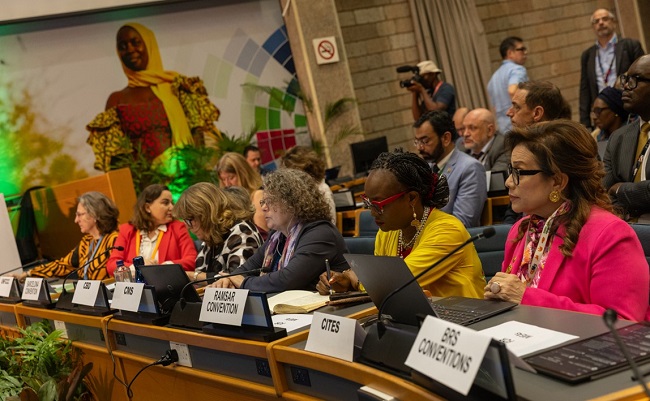
UNEA-7 concluded with the adoption of 11 resolutions, three decisions and a Ministerial Declaration, reaffirming Member States’ commitment to multilateral solutions to address the triple planetary crisis of climate change, biodiversity loss and pollution. CITES engagement underscored the essential role of multilateral environmental agreements (MEAs) in effective multilateralism, translating global commitments into effective, coordinated action on the ground.
During UNEA-7, CITES Secretary-General, Ivonne Higuero, delivered three key interventions and contributed to a joint statement through the Biodiversity Liaison Group (BLG), highlighting the essential role of multilateral environmental agreements (MEAs) in addressing the triple planetary crisis, stating: “As we look ahead and, reinforced by our CITES CoP20 last week, our priority commitment is clear: strengthen multilateralism and work with Parties, other MEAs and partners across society so that MEAs act as catalysts for sustainable development. Leveraging these synergies will help us collectively deliver on the [Sustainable Development Goals] SDGs for planet and people.”
At the UNEA Plenary the Secretary-General underscored that biodiversity is deeply interconnected with global trade, culture, and economies, and cannot be treated in isolation. She highlighted the unique mandate of the Convention and reflected on the outcomes of the recently-concluded 20th World Wildlife Conference (CITES CoP20) in Samarkand, Uzbekistan – including 82 new species listings, decisions to further strengthen effective implementation of the Convention, Resolutions on jaguars and eels, and stronger measures against wildlife crime – calling for breaking governance silos and investing in practical tools to turn commitments into results.
During MEA Day, the Secretary-General Higuero stressed the 50-year legacy of CITES as a legally binding mechanism supporting conservation and sustainable trade. She called for integrated approaches linking biodiversity with supply chains and finance and urged Parties to align policies and leverage UNEA’s convening power to foster cooperation and digital innovation, concluding: “Partnership is not a choice – it is the key to a future where progress benefits everyone.”
CITES joined seven other biodiversity-related conventions of the BLG in welcoming UNEA-7’s focus on sustainable solutions. The statement called for moving “from silos to systems” to address interconnected challenges and highlighted practical steps such as harmonized reporting and digital platforms to ease burdens on countries, reaffirming readiness to support Parties in achieving shared objectives for a sustainable future.
Youth engagement was also highlighted during UNEA-7, with the CITES Secretariat underscoring the importance of meaningful youth participation in strengthening biodiversity action and implementation across multilateral environmental agreements. The Secretariat also highlighted the growing recognition of youth engagement within CITES, including at CITES CoP20, where Parties amended the CITES Youth Resolution to recognize the CITES Global Youth Network, which brings together more than 100 young people from 73 countries.
The CITES Secretariat contributed to a range of official MEA side events and associated events held throughout UNEA-7, reinforcing its commitment to collaboration, innovation, youth engagement and science-based policy. These included:
- Joining Forces: How MEAs Drive Compliance and Enforcement Against Illegal Traffic (video recording available here)
- Leveraging AI for better cooperation, collaboration and impact for MEAs (video recording available here)
- GEF-MEA Exchange on Financing: From synergies to solutions – achieving a resilient, nature-positive, pollution-free future through GEF-9 (video recording available here)
- Integrated Actions for a Resilient Planet: ACP-MEAs III Achievements and Pathways forward (video recording available here)
- Youth Leadership for Biodiversity: Supporting MEA Collaboration for a Resilient Planet (video recording available here)
- Bridging Science and Policy: Strengthening Resilience to Tackle the Environmental Crisis.
As UNEA-7 came to an end, discussions underscored the importance of environmental agreements and institutions working together to address the interconnected challenges of biodiversity loss, pollution and climate change.
Exchanges in Nairobi highlighted the growing recognition that coordinated and complementary action across these three crises is essential, including through species conservation and sustainable trade, to deliver practical solutions that benefit both people and the planet.