

Civil society organisations (CSOs) in Adamawa State have expressed concern over poor access to direct funding, calling for urgent government intervention to sustain humanitarian and development operations across Nigeria.
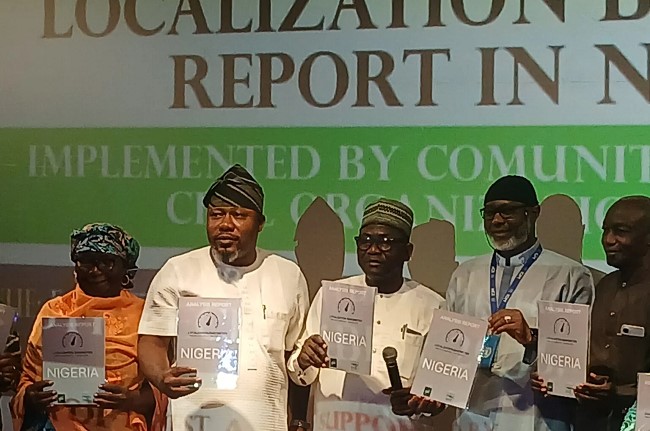
Mr. Peter Egwudah, Chairman of the Network of Adamawa Non-Governmental Organisations (NANGO), made the call on Wednesday, December 17, 2025, in Yola, the state capital, during the unveiling of the Nigeria Localisation Barometer Report.
Egwudah said limited access to direct funding remained a major challenge facing local organisations, in spite of global commitments to strengthen locally led humanitarian responses.
He recalled that the 2016 Grand Bargain agreement in Istanbul set a target of allocating at least 25 per cent of humanitarian funding to national actors, noting that the benchmark had yet to be met.
According to him, inadequate funding is already affecting the capacity of local CSOs to respond effectively to conflict-induced and climate-related humanitarian crises.
He added that dwindling donor support had further constrained operations, making it necessary to assess the localisation agenda and advocate stronger government involvement.
Egwudah noted that governments at the federal, state and local levels did not directly fund NGOs, stressing the need for advocacy to encourage public investment in humanitarian response.
He said humanitarian crises had spread nationwide, citing insecurity in the North-East, North-West and North-Central, oil spillage in the Niger Delta, and other socio-economic challenges.
Egwudah added that Nigeria hosted more than three million internally displaced persons, requiring stronger government ownership and increased budgetary commitment.
He stressed that humanitarian assistance should not be left solely to international organisations, urging government investment to ensure sustainability and accountability.
Also speaking, Mrs. Amy Gaman, Managing Director of Nuru Nigeria, said the 25 per cent funding commitment to local actors had not been realised, adding that it might not have reached 10 per cent.
Gaman urged federal and state governments to support the localisation model through counterpart funding, noting that development efforts were anchored on strong government leadership.
By Talatu Maiwada