

Stakeholders in the environment sector have called for concrete implementation of existing policies, financial commitments to effectively address the global climate crisis.
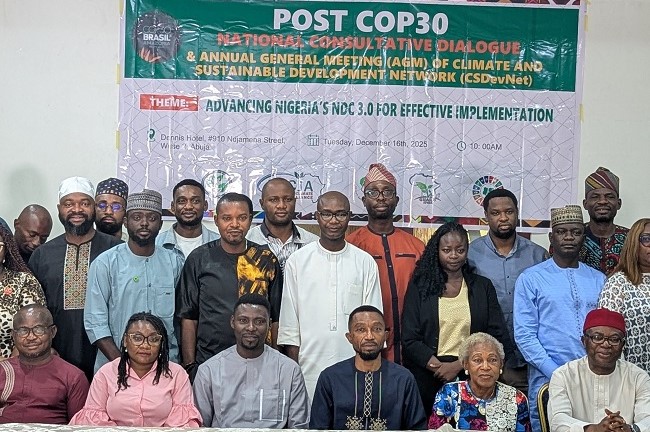
They made the call at the Post COP30 National Consultative Dialogue on Advancing Nigeria’s Nationally Determined Contribution (NDC) 3.0 at the Climate and Sustainable Development Network (CSDevNet) Annual General Meeting in Abuja on Wednesday, December 17, 2025.
Rep. Sam Onuigbo, CSDevNet Patron, said that global climate action has entered a new phase, shifting from pledges to concrete implementation.
“For Nigeria, the Nationally Determined Contribution under the Climate Change Act 2021 remains the central framework guiding national climate action.”
He highlighted the importance to ensure that post-COP30 priorities response to the lived experiences of communities facing climate impacts, while promoting equity, inclusiveness, and a just transition.
Onuigbo further identified key opportunities within NDC 3.0 implementation, including; Strengthening mitigation and adaptation measures, scaling up nature-based solutions, enhancing transparency and accountability in climate governance, expanding renewable energy deployment and green job creation.
He also emphasised the potentials of Nigeria’s emerging carbon market to mobilise climate investment and accelerate emissions reduction, and stressed on the need for strong environmental integrity and community safeguards.
He reaffirmed his commitment to collaborative, evidence-driven climate action and expressed optimism that Nigeria can emerge as a continental leader in low-carbon development and climate resilience.
“Post COP 30 priorities must respond to the lived experiences of communities grappling with climate shocks, farmers contending with shifting seasons, young people seeking green livelihoods, and institutions working to protect ecosystems.
“Implementing Nigeria’s NDC 3.0 offers us an opportunity to deepen mitigation pathways, expand adaptation finance, enhance nature-based solutions, and reinforce the transparency frameworks that underpin trust in our climate governance,” Onuigbo said.
Dr Sam Ogallah, Head of Unit, Climate Change, Africa Union, worried that Africa did not create the climate crisis, but Africa is paying the highest price.
“The outcome of COP30 reinforced the long-standing African demands for protection of livelihoods, jobs and development prospects fair and just transition pathways and scaled adaptation loss and damage support.
“Nigeria’s NDC 3.0 rightly prioritises emissions reduction of greenhouse gases by 29 per cent by 2030 and 32 per cent by 2035 (from 2018 levels) and energy transition by 50 per cent of national power from renewables by 2030,” Ogallah said.
Prof. Ibrahim Choji, Chairman of the CSDevNet Board, reaffirmed the Network’s strong commitment to aligning Nigeria’s national climate priorities with global climate processes.
Choji said that Nigeria had experienced significant climate-related challenges, including devastating floods, rising food insecurity, and increasing vulnerability among communities.
Inspite of these challenges, he highlighted positive developments such as the validation of Nigeria’s NDC 3.0, gradual progress in climate-related policies, and renewed global momentum following COP 30.
He reiterated that CSDevNet remains committed to translating climate policies into action by amplifying civil society voices in national and global climate spaces, supporting grassroots and community engagement and accountability in climate governance.
Also, he emphasised that civil society plays a critical role in ensuring that climate commitments move beyond policy documents and result in measurable improvements in people’s lives,“ Choji said.
Mrs. Anna Kalu, a representative from the Federal Ministry of Agriculture and Food Security, said that COP30 emphasised the interconnectedness of agriculture, food security, climate resilience, and sustainable development goals.
“For Nigeria, these outcomes resonate with national mandates to enhance sustainable agricultural productivity, strengthen resilience to climate shocks, and safeguard food production for a rapidly growing population.”
She reaffirmed the Ministry’s commitment to align with COP30 outcomes national policies, climate adaptation plans, and ongoing agricultural governance reforms.
“As we move into the post-COP 30 implementation phase, the ministry will continue engagement with CSDevNet in translating ambition into impact for climate-secure food security for Nigeria,” she assured.
By Abigael Joshua