

Nigeria has taken a major step towards strengthening its electronic waste governance system with the formation of the Nigeria E-Waste Sounding Board, inaugurated during a two-day stakeholder workshop on Sustainable Consumption and Production (SCOPE) held in Lagos from December 10 to 11, 2025.
The Stakeholders’ Workshop on E-Waste and Textile Waste in Nigeria, organised by the Resource and Environmental Policy Research Centre (REPRC), Environment for Development (EfD) Nigeria, brought together government agencies, academics, private-sector actors, civil society groups, and representatives of the informal recycling sector to co-create solutions to the country’s rapidly escalating e-waste challenge.
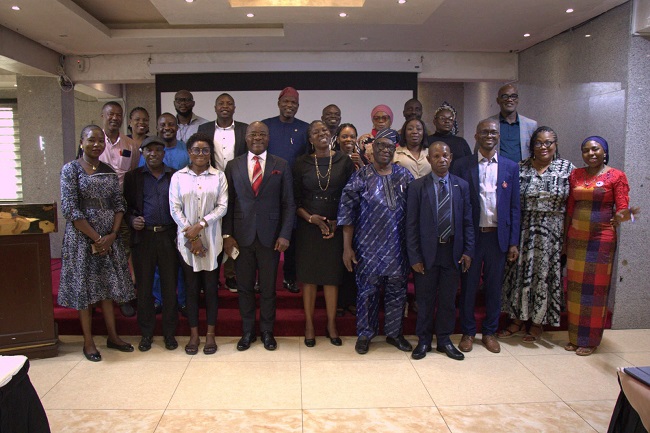
The Sounding Board, formally initiated during the opening session, is designed as a multi-stakeholder advisory platform to guide evidence-based research, validate national e-waste data needs, and strengthen coordination among actors. It will also support the implementation of Extended Producer Responsibility (EPR) systems and promote inclusive governance by formally engaging the informal sector – one of the most active yet least integrated components of Nigeria’s e-waste economy.
Highlighting the significance of the Sounding Board, Dr. Ifeoma Anugwa of REPRC/EfD Nigeria explained that the platform would serve as a bridge between research, policy, and practice, ensuring continuous collaboration long after the workshop.
Structured around five pillars – government, academia, private sector, informal recyclers, and civil society/development partners – the Board will meet twice annually, supported by quarterly virtual updates and thematic working groups on key issues such as EPR compliance, health and environmental risks, and digital monitoring of waste flows. EfD Nigeria will serve as the interim secretariat, coordinating meetings, documentation, research-policy matchmaking, and stakeholder communication.
Speaking during the opening ceremony, Professor Nnaemeka Chukwuone, Director of REPRC/EfD Nigeria, emphasised that the initiative is rooted in finding local, context-specific solutions.
“The workshop is not just about making policy – it is about local solutions,” he said, noting that Nigeria’s e-waste problem is embedded in everyday economic activities, from informal pickers at dumpsites to traders at Ikeja Computer Village, making it essential to bring all actors into the same conversation.
He described the Sounding Board as a “sandbox” for co-creation, where producers, recyclers, regulators, waste pickers, and researchers can jointly interrogate evidence, evaluate ongoing research, and develop implementable solutions that will inform national policy.
In his address, the Vice Chancellor of the University of Nigeria, Nsukka, Professor Simon Uchenna Ortuanya, reaffirmed the institution’s commitment to producing research that meaningfully informs policy and industry practice. He warned that Nigeria is facing an unprecedented surge in electronic consumption and fast fashion, both of which are generating waste streams that pose growing environmental and public health risks.
Professor Ortuanya stressed that sound science, strong institutions, and inclusive governance are essential for tackling these challenges. He emphasised that the SCOPE workshop serves a triple purpose: introducing a new research project on e-waste and textile waste, assessing Nigeria’s policy and data gaps, and establishing a multi-stakeholder mechanism – the newly inaugurated Sounding Board – to guide future engagement.
Participants at the workshop reached consensus on key operational decisions, including membership composition, meeting schedules, and EfD Nigeria’s role as secretariat. The Sounding Board is expected to produce an annual Nigeria E-Waste Policy Evidence Report, priority research agendas, and policy briefs on issues such as EPR strengthening, informal-sector integration, and environmental safeguards.
As Nigeria seeks to align its waste governance framework with regional and global circular-economy agendas, the formation of the E-Waste Sounding Board signals a significant shift toward more coordinated, inclusive, and evidence-driven action.
By Ajibola Adedoye