

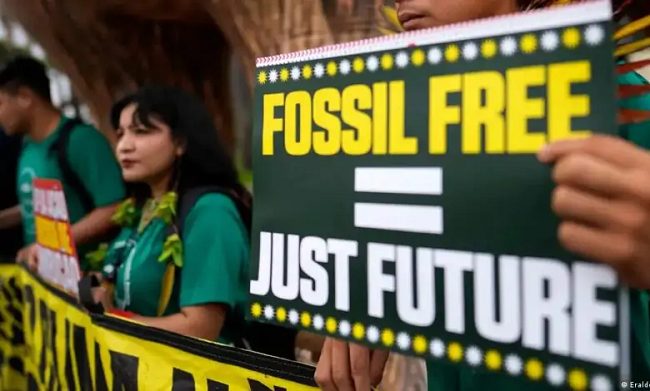
In just nine days, support for a fossil fuel phase-out roadmap has jumped from one to 62 countries – across both developed and developing nations, according to new analysis from 350.org and partners.
As COP30 enters its second week, support for establishing a Transition Away from Fossil Fuels (TAFF) Roadmap is accelerating fast. What began as a single call has become a powerful push to anchor a fossil fuel phase-out at the heart of the emerging Mutirão Pact.
Savio Carvalho, Head of Regions at 350.org, said: “The world needs a credible response to the gaping hole in climate ambition. Turning the COP28 promise into real action isn’t optional, we need urgent action to keep the planet livable.”
The global shift is already underway: renewables are growing faster than any other energy source.
“The real question now is whether the transition will be fair. Fossil fuels are about to peak, and emissions are set to fall. Countries need a just, orderly transition that is fair, fast, and funded – not a chaotic one defined by stranded assets. A justice-centred roadmap can protect people instead of sacrificing them.”
The proposed TAFF Roadmap would be bottom-up, showcasing real transition plans and policies already underway, and strengthening cooperation aligned with equity and the Paris Agreement.
But 350.org stresses that it must come with real support; finance, technology transfer, and capacity-building or it won’t be credible. Justice, adds the group, must be the starting point.
Indeed, a major diplomatic confrontation is taking shape at the UN climate summit in Brazil, where dozens of nations are pressing for a formal roadmap to phase out oil, coal, and gas – a move fiercely opposed by powerful fossil-fuel producers and industry lobbyists.
The push comes amid record global emissions from burning fossil fuels, which scientists say are driving deadly climate impacts and destabilising ecosystems worldwide. Despite years of negotiations, it was only at COP28 in Dubai that countries formally acknowledged the need to “transition away from fossil fuels.”
This year, momentum has grown. A broad coalition – including France, Colombia, Germany, Kenya, and many Small Island Developing States – is urging COP30 to adopt a concrete plan to accelerate the shift from oil, gas, and coal, dw.com reports.
Brazil’s President Luiz Inácio Lula da Silva, who has faced criticism for authorising new oil exploration in the Amazon, has nevertheless called for ending global dependence on fossil fuels and supports developing a clear timeline for their progressive phase-out.
Environment Minister, Marina Silva, echoed the message, describing a roadmap as essential to ensuring a “fair and planned transition.”
So far, about 60 countries across Europe, Africa, Latin America, and vulnerable island nations have backed the effort, with hopes of expanding support to at least 100. A draft declaration on phasing out fossil fuels prepared by Colombia is expected to be released early next week.
Resistance from major oil producers
But the initiative faces determined resistance. Saudi Arabia and other major oil-exporting states have reportedly rejected outright any reference to a fossil fuel phase-out roadmap. One negotiator estimated that as many as 70 countries may oppose the proposal.
Oil-producing nations argue instead for reducing emissions through technologies like carbon capture and storage – an approach criticized by experts because it has never been proven at global scale.
Diplomats say the coalition must be large enough to force the issue onto the summit’s agenda, a process described as a “diplomatic puzzle” with high stakes for the outcome of COP30.
Industry lobbyists in record numbers
Complicating matters further is the unprecedented presence of fossil fuel industry representatives. According to a report by the Kick Big Polluters Out coalition, 1 in every 25 participants at COP30 is linked to the oil, gas, or coal sector – totaling more than 1,600 delegates, including representatives from ExxonMobil, Shell, and TotalEnergies.
They outnumber nearly every national delegation except Brazil’s and hold significantly more passes than the 10 most climate-vulnerable nations combined.
Critics say their influence threatens to dilute ambition. “You cannot solve a problem by giving power to those who caused it,” said Jax Bonbon, a coalition member from the Philippines, which was recently hit by a devastating typhoon.
TotalEnergies CEO, Patrick Pouyanné, who attended the summit, rejected being labeled a lobbyist and expressed skepticism about the roadmap, calling it a “European vision.”
A warming planet and stark warnings
Global emissions from oil, coal, and gas reached a new high in 2025, and the world remains on track for a catastrophic 2.6°C rise in temperatures by 2100.
Johan Rockström, director of the Potsdam Institute for Climate Impact Research, warned that progress on other COP priorities — such as forest protection or climate finance — “can only be celebrated if we also see progress on the phase-out of fossil fuels.”
With pressure mounting and negotiations intensifying, COP30 appears poised for a decisive clash over the future of the world’s energy system – and the political will to confront what scientists call the central driver of the climate crisis.