

Once again, some Ghanaian journalists have been celebrated not just for their brilliant news items, but also how through the lens of factual storytelling, they have impacted stakeholders, particularly farmers to appreciate how some modern scientific tools can enhance farming. The awards ceremony reaffirmed the growing importance of evidence-based journalism in transforming public perceptions about agricultural biotechnology and its role in Ghana’s food security journey.
The annual awards, focused on media reportage on agricultural biotechnology is organised by the 10 African countries including Ghana, with functional Chapters of the Open Forum on Agricultural Biotechnology (OFAB) under the auspices of the Kenya based African Agricultural Technology Foundation (AATF).
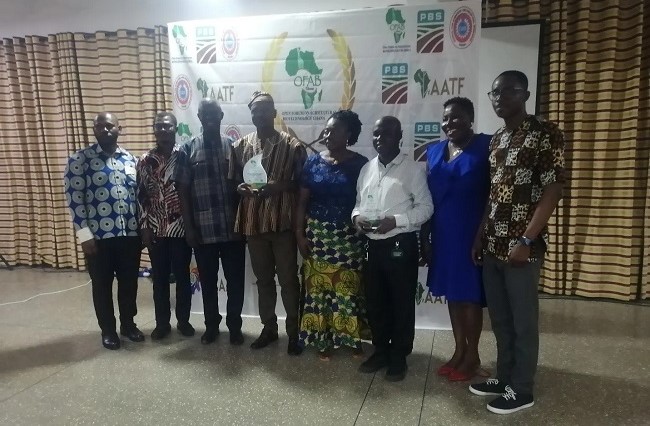
The 2025 Ghana OMA Awardees
The 2025 OFAB Media Awards (OMA) Ghana event, held in Accra about a fortnight ago, honoured two outstanding media workers who have used their platforms to demystify science and promote informed dialogue around agricultural biotechnology.
Solomon Gumah of the Tamale Office of the Ghana News Agency was one of the awardees. His story, was on the impact of the official release of the Pod Borer Resistant (PBR) Cowpea, by the Council for Scientific and Industrial Research Savannah Agricultural Research Institute (CSIR-SARI) and its partners in Nyankpala, in the Tolon District of Ghana’s Northern Region.
This variety of cowpea popularly known as the black eye beans has been genetically engineered to resist the bod borer pest, which has been a menace to farmers across the West Africa Sub-region. Gumah’s story, which won the Print/Online Category of the OMA, highlighted how the innovation was inspiring women’s access to farmlands and agricultural opportunities in the area.
Noah Nash Hoenyefia, who is the Northern Regional Correspondent of the Excellency in Broadcasting EIB) Network received the Television Category award. His story successfully captured the intersection of innovation, local realities, and scientific responsibility. It portrayed biotechnology not as a magic bullet, but as a dynamic process shaped by collaboration between researchers, regulators, and farmers.
This year’s event, was themed: “Promoting Credible and balanced Science Reporting for Quality Seed Development and Food Security.” It projected the power of evidence-based reporting in advancing biotechnology adoption, and underscored how credible journalism can build bridges between science and society; particularly in an era where misinformation can easily overshadow years of scientific research.
Each of the awardees received a plaque, a cheque for GHS 3000.00 and a hamper of assorted provisions. In addition to that, they will be sponsored to the African OMA events, which is the climax of OFAB’s Annual Review and Planning Meeting (ARPM) in Nairobi, Kenya.
The weeklong meeting opened on Monday, November 17 and ends on Friday, November 21, 2025.
A Growing Movement for Science-Focused Journalism
Former Director of the Biotechnology and Nuclear Agriculture Research Institute (BNARI) of the Ghana Atomic Energy Commission (GAEC), Professor Kenneth Danso, who chaired the event, praised the OFAB initiative for nurturing a new generation of science communicators.
“The quality of media stories has greatly improved and reflects the growing interest of the Ghanaian journalists in science and biotechnology reporting, and helping the public see the benefits rather than the fears,” adding: “That’s how we build trust.”
Prof. Danso, who is a member of the Vetting Committee explained that the core selection criteria were: originality, creativity and ability of the journalists to communicate complex scientific concepts to the public in simple and engaging ways.
Touching on the cowpea, which is now under commercial production, he said the product is already helping farmers, particularly in northern Ghana. “This crop is climate-smart and environmentally friendly. It lowers production costs and contributes to environmental protection.”
Prof. Danso urged journalists to continue highlighting both the progress and the challenges in biotechnology adoption, including farmer education, seed regulation, and market access, to ensure that innovation translates into real benefits for society.
The Awards not just an honour but an opportunity to shape Africa’s agricultural future
In a stirring goodwill message, Gloria Anderson of the Radio News Division of the Ghana Broadcasting Corporation (GBC) and a former OFAB Award winner, stated: “Tonight, we are not simply giving awards, we are recognising impact. We are acknowledging individuals and institutions who are pushing forward Africa’s dream of food security, sustainability, and agricultural innovation.
She reminded recipients that their recognition marked the beginning of a new chapter of responsibility. “This award is not an end – it’s a platform, a microphone, a doorway,” and urged them “to use your voice to speak boldly to policymakers, farmers, and communities. Build partnerships, mentor others, and stay engaged.”
Anderson highlighted how winning the OFAB Award opens doors for visibility, partnerships, and influence in policy circles, noting that “these are benefits that ultimately enhance public understanding of science and technology.
She also encouraged young journalists to see the awards not only as an honour but also as an opportunity to shape Africa’s agricultural future. “The OFAB network is a family,” she said “and solutions scale, when we collaborate.”
Celebrating the partnership between science and journalism
The Public Affairs Officer of the Ghana Journalists Association (GJA), Zadok Kwame Gyesi, described science and journalism as “two forces that, when brought together, help society make sense of complex realities.”
He underscored that both disciplines are indispensable to national development. “We cannot take science out of our lives, just as we cannot take journalism out of our lives,” he said. “When the two come together, society benefits immensely.”
Zadok commended Ghanaian scientists for achieving a historic milestone with the PBR Cowpea – the country’s first genetically modified (GM) crop approved for commercial cultivation in 2024. He noted that “the crop, offers farmers protection against the destructive Maruca vitrata pest, reduces pesticide use, and ensures higher yields.”
However, he observed that this scientific breakthrough had been accompanied by waves of misinformation, a challenge that underscores the importance of responsible media coverage. “The same media that can spread misinformation also has the power to correct it,” he emphasised. “Evidence-based reporting is our best defence against propaganda and fear.”
Zadok outlined that evidence-based reporting relies on verifiable data, peer-reviewed research, and credible sources. Such reporting, he explained, strengthens public trust, empowers farmers and consumers, and helps policymakers make informed decisions about technologies such as biotechnology. He also urged both scientists and journalists to build a “mutually beneficial relationship” anchored in transparency and trust.
OFAB Ghana: A decade of fostering informed dialogue
In a statement, OFAB Ghana’s Coordinator, Dr. Richard Ampadu, recounted how since its establishment in 2011 and hosted by the CSIR, how the initiative has fostered understanding of agricultural biotechnology and bridged communication gaps between scientists, policymakers, and the public.
His statement, read on his behalf by OFAB Ghana’s Project Manager, Enoch Ilori, explained how the group does its work: “OFAB Ghana facilitates informed decision-making through conferences, workshops, and stakeholder engagements.” This is in line with its mission: “to educate and update the public about the role of biotechnology in addressing Ghana’s food and agricultural challenges.”
On the OMA, the statement said, the award scheme was instituted to celebrate journalists who report on agricultural biotechnology with balance, accuracy, and depth, noting that over the years, the awards have become a flagship platform for promoting science journalism in Ghana.
“Despite misinformation and fear, biotechnology holds transformative potential for addressing food security, climate change, and declining yields,” the statement said, and emphasised that “the media’s role in bridging this knowledge gap cannot be overemphasised.”
Dr. Ampadu, who is also a Deputy Director at the CSIR- Science Technology Policy Research Institute congratulated this year’s winners for their exemplary work in science journalism, noting that their commitment continues to inspire public confidence and shape national discourse on agricultural innovation.
Conclusion
In a world where misinformation travels faster than facts, Ghana’s growing cadre of science journalists is proving that evidence-based communication remains one of the strongest tools for national development. Through their work, they continue to build the bridge between the laboratory and the community – ensuring that innovation truly reaches the people it was designed to serve.
The 2025 OFAB Media Awards reaffirmed that when science and journalism work hand in hand, societies become more informed, policies more effective, and technologies more trusted.
By Ama Kudom-Agyemang