

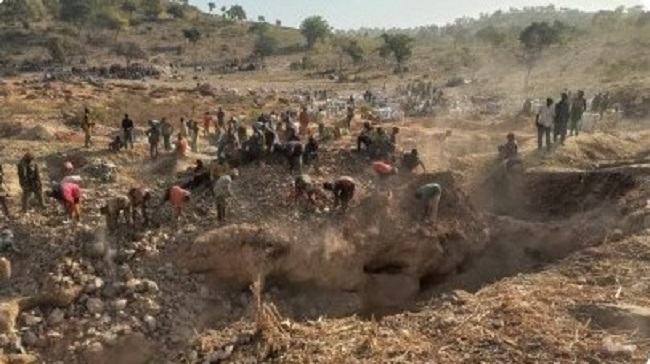
Ngaski Local Government Area in northwestern Kebbi State with its headquarters at Wara and lying on the shores of Kainji Lake near the Niger River in Nigeria is an agricultural community where millet, sorghum and maize once defined livelihoods. Today, however, artisanal gold mining has reshaped parts of its landscape and its prospects.
Photographs compiled by the Nigerian Youth Biodiversity Network (NYBN) show sluice pits, crushed ore, and open tailings that now scar fields once used for food and grazing.
As a youth-led and youth-focused organisation, the NYBN is alarmed by a widening convergence of harmful practices: mercury-dependent mining methods, rapid land degradation, declining biodiversity, youth exposure to toxic work, and the growing insecurity that blocks help and reform.
The Minamata Convention, the global pact to protect human health and the environment from mercury places this issue squarely within international concern. For youth advocates, mercury pollution in artisanal mining is not only an environmental problem; it is an intergenerational justice issue.
Listening to local voices: nuance, need and aspiration
On the ground, community perceptions are complex. An interview conducted with a local respondent – later translated by NYBN (from Hausa to English) – captures that ambivalence. The interviewee explains that gold mining is an age-old activity in the region, practiced “since I was born,” and that the work provides crucial income and food security, yet it remains insufficient to cover healthcare needs or secure long-term well-being.
They report visible changes in water quality and landscape, and they acknowledge awareness of mercury’s dangers. They also eagerly welcome training on safer mining methods. They described prior attempts to engage government but expressed little confidence in official assistance.
This testimony highlights three truths: (1) artisanal mining is socially and economically embedded; (2) local people perceive environmental change and exposure risks; and (3) communities want alternatives and capacity-building, but distrust and institutional neglect hinder progress. Any effective response must start with these lived realities.
The ecological and human stakes
Where mining proliferates without safeguards, fragile habitats are fragmented, soils erode, and waterways carry sediment and chemical residues downstream. Young people often present at sites from infancy are especially vulnerable to the chronic harm of contaminants and the immediate dangers of unrehabilitated pits.
The combination of degraded land, weakened livelihoods, and limited public support creates a feedback loop: declining agricultural productivity pushes more households toward hazardous mining practices, amplifying risks to biodiversity and human health.
Barriers to intervention: insecurity and governance gaps
Beyond environmental damage, many gold-bearing regions face security challenges that make solutions difficult to implement. Where non-state armed actors exert control, access for health workers, researchers and civil society is blocked and formalization efforts falter. Weak oversight, coupled with constrained local trust in government, means that top-down policies alone will not succeed.
Conclusion
Ngaski’s story is not an inevitable tragedy. It is a crossroads where youth energy, community knowledge, and international frameworks such as the Minamata Convention can converge to turn extractive desperation into regenerative opportunity.
The Nigerian Youth Biodiversity Network stands ready to convene partners, share local testimony, and shepherd pilot efforts that protect both people and biodiversity – so that the land and the children who will inherit it have a future worthy of them. As youth with utmost concern for our environment and the future that we look forward to, we urge the government and stakeholders on the following:
- The National Gold Purchase Programme of the Ministry of Solid Minerals should be comprehensive so that it brings holistic development into the mining landscape and scrap artisanal and other forms of illegal mining across geopolitical zones
- The governments of Kebbi and Zamfara states should immediately intervene into the environmental health problems and destruction of natural ecosystems caused by artisanal gold mining activities in the states. Artisanal miners are humans, and as such need ultimate health care and favourable working conditions. Labour exploitation at gold mining sites must be criminalized.
- We call for a national policy framework on solid minerals and the mining industry. This national policy framework should be strengthened with legislative provisions, sanctions and incentives for good practices.
- Nigeria needs to play key role in the implementation of the provisions and objectives of the Minamata Convention. Mercury and other harmful chemicals must be abolished in all its forms; both industrial usage and domestic use in skin care products must be sanctioned.
By Suleiman Bello Sule and Mayokun Taylor, Chemicals and Waste Task Force, Nigerian Youth Biodiversity Network