

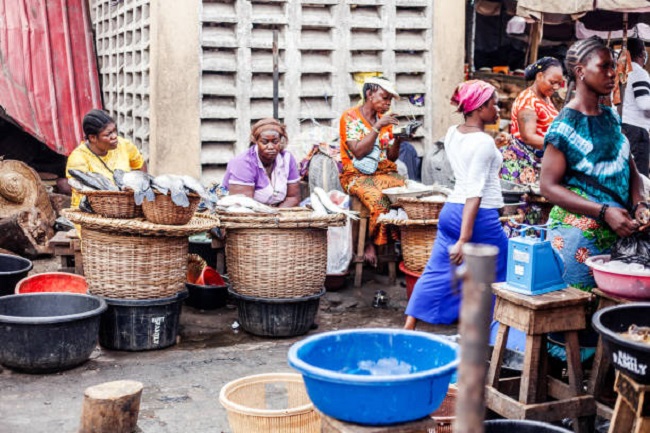
In every flood that sweeps through Lagos’ coastal communities or any coastal community in Nigeria, we see more than homes lost; we see untapped climate intelligence washed away. Along the Atlantic coast, women fishers have spent generations reading tides, tracking fish migration, and predicting storms long before weather apps existed.
Our new study, published in Marine Policy, titled “Marine Policy and Community Engagement: Rethinking the Role of Vulnerable Groups in Climate and Ocean Action on Lagos’ Atlantic Coast, Nigeria”, shows why this knowledge matters not just for survival but for government decision-making. Read the full study here: Elsevier Marine Policy Journal.
Why This Matters for Government
Nigeria’s climate response cannot succeed without local participation. Coastal communities in Lagos are on the frontlines of sea-level rise, flooding, and erosion, yet over 80% of women we interviewed had never been consulted in any adaptation program. For government, this exclusion is not just a social oversight; it is a policy inefficiency. Valuable, field-tested knowledge remains outside the formal system, leaving agencies to rely on models that miss local realities.
Integrating Traditional Ecological Knowledge (TEK), the environmental wisdom passed down through generations, offers government three major advantages. First, women in Makoko and Ikorodu already use informal weather-signal systems based on tides, fish behavior, and wind shifts. Integrating these networks into the state’s disaster-response systems could drastically improve early warnings. Second, TEK provides hyper-local data that can refine climate risk mapping and adaptation planning, reducing costly trial-and-error interventions. Third, policies co-created with local people are more likely to be accepted, implemented, and maintained over time.
Findings That Policymakers Should Not Ignore
Between 2022 and 2024, we surveyed 540 women and women with disabilities across six coastal communities: Badagry, Epe, Makoko, Ikorodu, Mosafejo, and Oyingbo. Ninety-eight percent of respondents had experienced extreme flooding or sea surges. Seventy-one percent reported declining fish catches, and 16% reported worsening water quality. Eighty-two percent said they had never received government support for adaptation.
Despite these challenges, resilience was everywhere. In Epe, women used cooperative savings groups to rebuild after floods. In Badagry, fishers adjusted catch times to match changing tides. In Ikorodu, they developed informal “signal systems” using drums and bells to alert neighbors before heavy storms. These are not random acts of survival; they are community governance systems that function where formal mechanisms fail. For Lagos State and federal ministries, this is a chance to align national plans with local experience.

Bridging Two Worlds: Science and Tradition
The Lagos Climate Adaptation and Resilience Plan (LCARP 2024) provides a solid framework for infrastructure-based adaptation, including drainage systems, coastal reinforcements, and flood mapping. However, it leaves a critical gap: it does not specify how communities will help shape or implement these measures.
Our research proposes a Dual Adaptation Model in which Traditional Ecological Knowledge complements scientific data. Government agencies could create Community Climate Desks within local councils to record and verify TEK observations, train local women cooperatives as 10/29/2025Climate Monitors to bridge early-warning data with state emergency systems, fund solar-powered cold storage hubs to address post-harvest losses and strengthen economic resilience, and include TEK modules in national marine education curricula and coastal policy guidelines. This is not about replacing science with folklore; it is about expanding the evidence base for smarter policy decisions.
The Economic Argument
Every flood and every ruined fishing season carries a cost. By ignoring locally generated intelligence, government bears higher losses in emergency response, food security, and infrastructure repair. The World Bank estimates that Nigeria loses billions annually to climate-related disasters. Many of these losses could be reduced if communities were empowered to act as first responders, with recognition, training, and micro-grants that enable them to maintain early-warning systems and adaptive infrastructure. Simply put, integrating TEK is fiscally sensible. It turns communities into partners in governance rather than dependents on relief.
A Governance Shift: From Consultation to Collaboration
Climate adaptation will succeed only when people feel ownership. The women of Lagos’ coastlines have demonstrated that ownership. What they need now is institutional recognition. Government can take three immediate steps: formalise participation by including community representatives in state and national climate councils; fund locally led pilots that merge TEK and scientific monitoring, such as mapping tidal change indicators alongside meteorological data; and mainstream TEK in legislation through amendments to marine and coastal policy frameworks, ensuring that knowledge from vulnerable groups is preserved and protected.
A New Social Contract with Coastal Communities
This is more than an environmental issue; it is a test of inclusive governance. Lagos’ fisherwomen are not just adapting to climate change; they are modeling the participatory resilience Nigeria’s policy frameworks aspire to achieve. By listening to and investing in these communities, government can turn adaptation from a reactive response into a proactive, locally informed system that saves money, protects livelihoods, and advances the Sustainable Development Goals (SDGs 13, 14, 1, and 6). If climate policy is to endure, it must begin where resilience already exists in the hands, voices, and lived knowledge of the people the ocean touches first.
By Abimbola Abikoye (MBA Candidate at UNC Kenan-Flagler Business School and Founder of Revamp Rave Network Initiative, advances climate education and coastal resilience in Nigeria) and Oluwatoyosi Abikoye (PhD Candidate at NOVA School of Law, Lisbon, studies maritime boundaries and ocean governance)