

The Intergovernmental Panel on Climate Change (IPCC) on Monday, October 27, 2025, opened its 63rd Plenary Session in Lima, Peru, bringing together some 300 delegates from IPCC member governments and observer organizations to advance its work in the seventh assessment cycle.
Over the four-day session, the Panel will continue discussions on the timelines for the three Working Group contributions to the Seventh Assessment Report (AR7), as well as on the draft outline and timeline of the Methodology Report on Carbon Dioxide Removal Technologies, Carbon Capture Utilisation and Storage.
In addition, the Panel will discuss the IPCC’s Trust Fund programme and budget for 2026, the indicative budget for 2027 and 2028, a proposal for an expert meeting, and other agenda items.
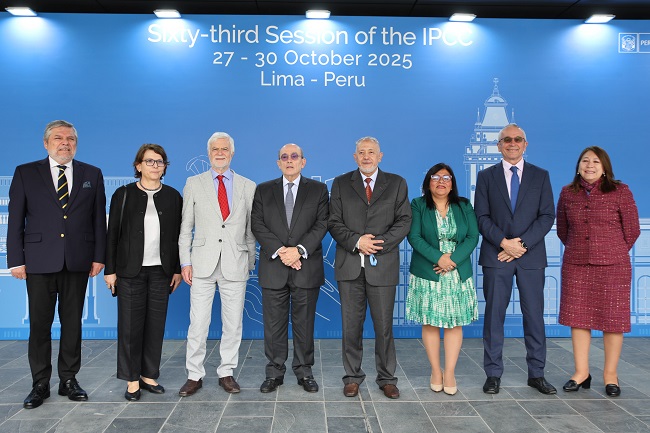
“By now, we know the scope of the Seventh Assessment Report, and we have selected the scientists who will be delivering the work,” said IPCC Chair, Jim Skea. “Building on the progress made so far, the Panel now needs to settle the important matter of the timelines for producing the reports, taking into account inclusive assessment practices and policy relevance. I trust that Panel members will seek consensus on the timelines in line with the IPCC’s established procedures.”
The Peruvian Minister of Foreign Affairs, Hugo de Zela, addressed the opening of the IPCC’s 63rd Plenary Session, reaffirming the country’s commitment to the global fight against climate change. In his remarks, Minister De Zela urged member states to act with a sense of urgency and responsibility to finalize the reports and methodologies necessary to accelerate climate action.
“Information produced by the IPCC remains essential to guiding the policy decisions of States seeking to reduce global warming,” said Minister De Zela.
The IPCC’s seventh assessment cycle formally began in July 2023 and will culminate in the release of the AR7 Synthesis Report in 2029. In this cycle, the IPCC will prepare the AR7, which comprises three Working Group contributions and a Synthesis Report, as well as update the 1994 Technical Guidelines for Assessing Climate Change Impact and Adaptation. The Panel will also produce a Special Report on Climate Change and Cities, and two Methodology Reports.
Delegates were welcomed at an opening ceremony in Lima, which included remarks from Peru’s Minister of Foreign Affairs, Ambassador Hugo de Zela; Deputy Minister of Strategic Development of Natural Resources for Peru’s Ministry of Environment, Raquel Hilianova Soto Torres; the IPCC Chair, Jim Skea; and Director of Climate Change Division of the UN Environment Programme (UNEP). Martin Krause.
The opening also included projections of video messages from Celeste Saulo, the Secretary-General of the World Meteorological Organisation and Simon Stiell, the Executive Director of the United Nations Framework Convention on Climate Change.