

The Nigerian Environmental Society (NES) has advocated for the enactment of stringent legislation to help address the worsening problem of poor waste management in Nigeria.
According to the group, Nigeria’s waste management challenges constitute a national disaster that necessitates the enactment of laws to enforce waste segregation from its source. Additionally, it is essential to integrate public awareness campaigns and robust institutional frameworks as fundamental components in reversing this troubling trend.
Speaking at a meeting it hosted in Abuja on Thursday, October 23, 2025, to celebrate its 40 years of existence and achievements, the president of the association, Dr Efegbidiki Okobia, told the participants that the NES would soon launch the Nigerian Environmental Outlook, a new tool that will track national environmental indicators and guide evidence-based policymaking.
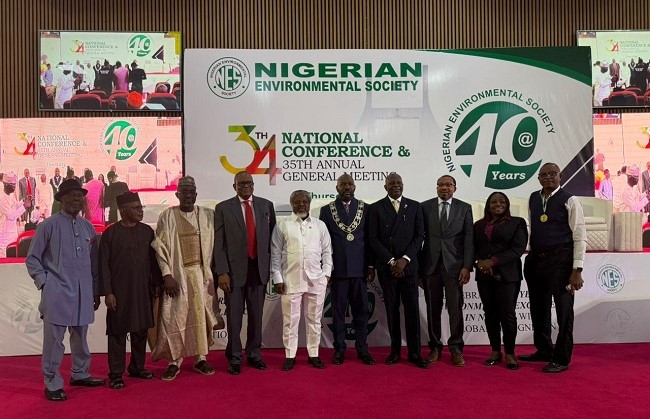
“This is the beginning of another 40 years,” he said, because the roadmap will focus on practical implementation of the Nationally Determined Contributions (NDCs) and ensure that climate commitments get to the grassroots.
Dr Okobia, who expressed extreme delight over the milestone achievements of the NES since the last four decades, hinted that it has made giant strides with different partners across government and the private sector.
Reflecting on the historical record of his organisation, he reminisced about its inception with just ten professionals, primarily from the oil and gas sector. Since then, the society has expanded significantly, now comprising 35 chapters across Nigeria, in addition to one located in the United Kingdom.
The body also championed the passage of the Institute of Environmental Practitioners (IEP) of Nigeria Act in May 2023, a noteworthy accomplishment, which the NES boss described as a major breakthrough.
“That act has given a voice to environmental practice as a foundation in Nigeria,” he said.
Sarah Mukherjee, President and CEO of the Institute of Sustainability and Environmental Professionals (ISED), United Kingdom, who delivered her message virtually, referred to the NES as “a beacon of what can be achieved when a group of people come together with a vision and complete the hard work.”
Sarah, who spoke on the theme of Nigeria’s Contribution to Global Climate Action, congratulated the society for its 40 years of commitment to environmental advocacy, policy development, and capacity building.
“You should be rightly proud to celebrate 40 years of the society’s dedication to shaping national policies, from the National Policy on the Environment to the Environmental Impact Assessment Act,” she said. “It is a landmark achievement.”
She noted that many NES members have served on inter-ministerial committees, offered technical advice, and represented Nigeria at international environmental negotiations.
“The capacity of the Institute for Technology and professional collaboration has contributed significantly to the country’s environmental governance,” she added.
Sarah also drew parallels between Nigeria’s environmental challenges and those faced globally, citing issues such as waste management, pollution control, and energy efficiency as “shared struggles that demand shared learning and solutions.”
“There is so much that we can learn from each other,” she said, citing examples of flood adaptation work in Copenhagen where overflow areas were transformed into flood-proof cycling lanes. “These are the kinds of innovations that reflect what sustainable urban living can look like.”
In his goodwill message, Mr Hamid Adekunle, one of the society’s founding members, reflected on its humble beginnings and expressed gratitude for its growth.
“There were ten of us who started the Nigerian Environmental Society. I thank Almighty God that I am alive to see 40 years of the seed we planted,” he asserts.
He praised the current leadership for achieving the long-sought professionalisation of environmental practice, and he urged the next generation to prioritise research and innovation that address Nigeria’s unique environmental realities.
“I would like to see the society focusing on research and technology that reflect who we are as a country,” he said. “Let us look at the challenges of our regions and craft local solutions, not imported prescriptions.”
By Etta Michael Bisong, Abuja