

The Yaku Mama Amazon Flotilla is launching a symbolic journey from the city of Coca in Ecuador to demand a new paradigm: placing the Amazon at the heart of the fight for climate justice and promoting an end to fossil fuel extraction and use.
Connecting the Andes to the Amazon, a coalition of 60 Indigenous and territorial organisations, alongside allies from around the world, will travel more than 3,000 kilometres toward COP30, to be held in Belém, Brazil, in early November. This journey is not just an act of protest but a powerful demand: climate justice must become a reality, and fossil fuel extraction in the Amazon must end now.
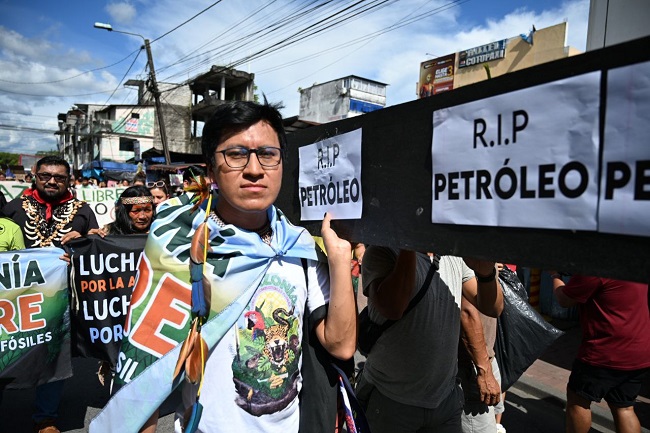
The flotilla participants previously gathered in Quito as a starting point. This choice was not merely symbolic but sought to confront history: it was from this city, in 1541, that Francisco de Orellana’s expedition departed, culminating in the “discovery” of the Amazon River. Today, the Yaku Mama Amazon Flotilla symbolically reverses that route of conquest into one of connection, honouring the resistance of Indigenous Peoples and the first continental uprising of 1992, with the goal of making the world finally listen to the voices of the territories.
“This journey is an act of resistance and empowerment that links the climate crisis to its colonial and extractivist roots, positioning the peoples who have contributed least to it as the most affected. It is an urgent call to COP30 to recognise that true climate justice is born from the land, flows with its rivers, and is sustained by those who protect it,” stated Lucía Ixchú, a Maya K’iche’ Indigenous woman from Guatemala and spokesperson for the flotilla.
To begin the journey, the flotilla’s crew, together with ally organisations, will hold a symbolic funeral to bid farewell to the era of fossil fuels that has devastated the Amazon. This collective action denounces the false solutions that, in the name of the energy transition, continue to impose extractive projects and new sacrifice zones on Indigenous territories. In response, the Amazonian peoples reclaim their right to decide over their territories and to lead the way toward a just and living transition without creating new sacrifice zones through mining, oil spills, and monocultures.
The Yaku Mama Amazon Flotilla demands a supposedly fair and binding energy transition. Indigenous Peoples urge governments and companies to ensure that any clean energy project respects Free, Prior, and Informed Consent (FPIC) and puts an end to fossil fuel developments that jeopardise their territories and ways of life.
At the same time, they call for the recognition and protection of intangible zones for Indigenous Peoples in Isolation and Initial Contact (PIACI), whose existence and well-being depend on territories free from exploitation. Protecting these forests not only guarantees the survival of these peoples but also preserves biodiversity, maintains global climate balance, and ensures the quality of life for all inhabitants of the planet.
The journey begins at a critical time for the Amazon. According to a report presented by the Monitoring of the Andean Amazon Project (MAAP) last year, 2024 marked a devastating record with the loss of 4.5 million hectares of primary forest due to deforestation and fires. This destruction is driven by the advance of extractivism; the same study reveals that deforestation from gold mining has increased by over 50% since 2018, with 36% of it occurring within protected areas and Indigenous territories.
The River That Flows: From History to Hope
“We are in Ecuador today for a very specific reason. Centuries ago, missions departed from Quito that claimed the ‘discovery’ of the Great Amazon River, bringing conquest to our territories,” affirmed Leo Cerda, a Kichwa Indigenous person from Napo, Ecuador.
“We too have come to Quito, that historic starting point, to reclaim this route. And on October 16th, from Francisco de Orellana – the city of Coca – we will embark on a new journey that honours the memory of struggle and resistance of the Amazonian Indigenous Peoples. We also dedicate this journey to the memory of October 12 as a symbol of the resilience of the Peoples of the Americas. We set out not to conquer, but to connect; so that the world, finally, will listen to the voices of the territory,” he added.
The flotilla is composed of a delegation of 50 people, including representatives of Indigenous peoples and civil society organisations from the Amazon, Mesoamerica, the Republic of Congo, and Indonesia. It will travel the Amazon River to denounce the “scars of extractivism” – such as illegal mining and deforestation – and, at the same time, highlight the strength of the living alternatives in their communities, such as productive enterprises, territorial monitoring, and ancestral science.
The Era of Fossil Fuels in the Amazon Must End
Fossil fuels not only harm the environment; they are a driver of social violence, according to observers.
Worldwide, especially in the Amazon, defending the territory has become a death sentence. According to the latest report from Global Witness, published in 2024, between 2012 and 2024 alone, at least 2,253 defenders have been murdered or have disappeared, 40% of whom were Indigenous.
Violence against the Amazon is manifested in the silent expansion of the oil and fossil gas industry. Between 2012 and 2020, the number of exploitation fields increased by 13%, and today, extraction is present in eight of the nine Amazonian countries. According to InfoAmazonia and Arayara, oil exploration overlaps with 441 ancestral territories and 61 natural protected areas, devouring the rainforest and directly threatening the lives and self-determination of Indigenous peoples. Across the Pan-Amazon, there are 933 oil and gas blocks, of which 472 are in Brazil, 71 in Ecuador, 59 in Peru, and 47 in Colombia, many located within protected areas or Indigenous territories.
The impact of this industry is devastating: between 2000 and 2023, Peru recorded 831 oil spills, and Ecuador, 1,584 between 2012 and 2022. In Brazil, the attempt to open a new oil frontier at the mouth of the Amazon – Petrobras’ FZA-M-59 block – was rejected three times by IBAMA due to risks to biodiversity. Deforestation associated with oil infrastructure, such as roads and pipelines, fragments the forest and facilitates access to previously untouched areas. Furthermore, gas flaring and spills contaminate air, water, and soil, affecting the health of 1.2 million people living within five kilometres of active wells, according to Greenpeace.
Climate change, driven by the burning of fossil fuels which generates 75% of global greenhouse gas emissions (IPCC-AR5), is pushing the forest to its limit: extreme droughts, severe floods, and a growing vulnerability to fire threaten to push the Amazon toward a point of no return.
Demanding climate justice is also demanding justice for those who sustain the planet’s hope. COP30 cannot continue with sustainability rhetoric while extractive projects keep expanding. The Yaku Mama Amazon Flotilla demands a fair and binding energy transition that respects the rights of Indigenous Peoples and guarantees an Amazon free of oil, gas, and coal. Only then will it be possible to protect the life, dignity, and biodiversity that the Amazonian peoples have always cared for.
“For us, the Indigenous Peoples, the climate crisis is not a distant problem. It is the invasion of our lands, the contamination of our rivers, and a direct threat to the lives of our children. Defending the Amazon is not just a fight for nature; it is a fight for our own existence. There can be no climate justice without justice for the peoples who have cared for this land for millennia. At COP30, we demand that they listen to our voices and take real action by banning fossil fuel extraction once and for all,” indicated Kelly Guajajara, a young Guajajara Indigenous woman from Brazil and representative of Midia Indigena.
Indigenous Peoples as Part of The Climate Solution
The flotilla carries the argument that Indigenous Peoples are not only victims of the climate crisis but are also actors with living solutions. Their journey is a testament to how ancestral knowledge and local practices are vital for global climate governance.
“This flotilla is not just a protest; it is a living message navigating the veins of the Amazon. The river itself shows us its scars: the oil slicks, the wound of mining. But in every community, we visit, we also find resilience and solutions. We are not just coming to bring a problem to COP30; we are coming to present the answers that our peoples and the forest have cultivated for millennia,” stated Alexis Grefa, a young Kichwa Amazonian from Ecuador.
In contrast to this devastation, the Flotilla seeks to highlight Indigenous Peoples as the most effective climate solution. Science backs this up: according to the 2024 MAAP report, Indigenous Territories and Protected Areas cover nearly half of the Amazon (49.5%) and store 60% of all its carbon. Between 2013 and 2022, while the rest of the basin became a net source of emissions, these territories functioned as carbon sinks, absorbing 257 million metric tons.
Studies show that Indigenous Peoples manage or have rights to a quarter of the Earth’s land surface, which contains 37% of the intact natural lands and a third of the planet’s forest landscapes. Biodiversity also remains more stable in these territories than in similar ecosystems outside of them, even in conflict zones.
This scientific backing confirms that Indigenous Peoples not only protect their territory and ways of life but also play a critical role in the global climate balance, a central theme of COP30.
Calls to Action and Key Demands for COP30
The caravan demands that decision-makers at COP30 take concrete measures to:
- Recognise and guarantee the territorial rights of Indigenous Peoples and local communities as the most effective climate strategy to protect forests, rivers, and biodiversity.
- Ensure direct funding without intermediaries for those who care for life, strengthening the protection of critical ecosystems and resilience to the climate crisis. Although $1.7 billion was pledged at COP26, 76% of the Green Climate Fund’s funds remain in the hands of international intermediaries.
- The energy transition cannot be repeated on the same wounded territories. Guaranteeing the full participation and decision-making power of Indigenous Peoples is essential to prevent the continued creation of new sacrifice zones in the name of progress.
- Integrate the protection of land defenders into all climate policies.
“Just a few days ago in Ecuador, we bid farewell to Efraín Fuérez, Rosa Elena Paqui, y José Alberto Guamán a Kichwa Otavalo leaders and territory defenders, who was murdered during the national strike. Their memory joins our journey as a reminder that demanding climate justice is also demanding justice for those who, with their lives, sustain the hope of the planet,” affirmed Leo Cerda.
“The flotilla is not just a journey: it is a demand. We are not going to Belém to ask for a space; we are going to demand that climate policies be built from the territories, with justice for those of us who care for life,” their declaration underscores.