

Delegates from member countries were welcomed in Brazil’s capital with billboards urging that the issue be included in the Pre-COP discussions
Less than a month before the United Nations Climate Change Conference, COP30, which will take place in Belém (PA), a crucial issue for the planet still hangs in the air, with no sign that it will be properly addressed: the gradual phase-out of fossil fuels. There is a real risk that a deal on this will once again be left out of the final declaration, repeating the failure of COP29, which was marked by the strong presence of pro-oil lobbyists.
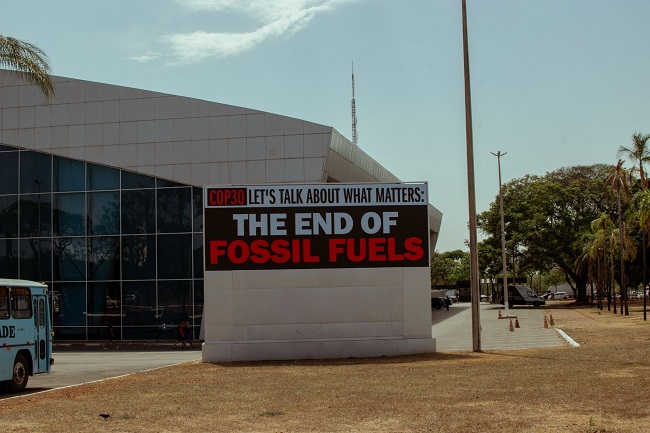
The burning of fossil fuels accounts for 70% of greenhouse gas emissions driving the climate crisis. That is why, at COP30, it is imperative for nations to reach a consensus on an ambitious plan with clear, concrete targets to progressively reduce the use of oil, gas, and coal, coupled with a just energy transition.
To reinforce this message, civil society organisations put up billboards across Brasília, which this week is hosting more than 30 heads of delegations for the Pre-COP – the last high-level meeting before Belém. The goal is to remind them that a real solution to the climate crisis necessarily involves ending the fossil fuel era.
At COP28 in 2023, the Global Stocktake (GST) – the Paris Agreement’s global progress assessment – recognised the shift away from fossil fuels as an urgent action for this critical decade. Countries also committed to tripling renewable energy capacity and doubling energy efficiency by 2030.
However, the lack of more ambitious commitments by countries, combined with a complex geopolitical landscape – marked by the rise of the far-right and inadequate, insufficient, and unjust international climate finance – will put governments’ climate pledges to the test. This scenario underscores the need for greater political and diplomatic pressure to ensure the next steps deliver clear and binding commitments.
It is essential for all negotiators to work effectively toward the success of COP30. A meaningful outcome must ensure progress in halting and reversing deforestation and forest degradation, as well as advancing all aspects of the COP28 energy package – including a just, orderly, and equitable transition away from fossil fuels. Implementation must be accelerated, which requires increased investment and support, including robust financial flows for a just energy transition in developing countries.