

On Tuesday, September 9, 2025, in Addis Ababa, Ethiopia, on the sidelines of the Second Africa Climate Summit (ACS2), the Pan African Climate Justice Alliance (PACJA) and partners officially launched the Climate Justice Impact Fund for Africa (CJIFA) alongside the Africa Just Resilience Framework (JRF).
The two instruments are designed to place African communities at the heart of climate action and finance.
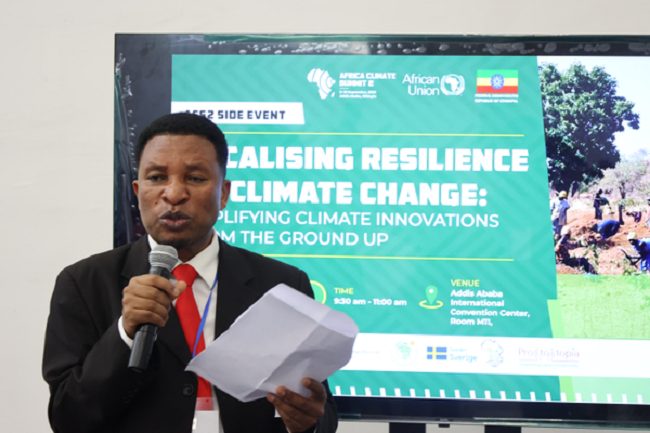
The launch marks what the promoters describe as a historic step in Africa’s climate resilience journey, addressing the long-standing injustices in global finance.
Speaking at the event, Dr Mithika Mwenda, Executive Director of PACJA, said that Africa is bearing the heaviest brunt of climate change. At the same time, it continues to receive a disproportionately small share of resources. He urged that existing financing systems remain rigid and exclusionary, often overlooking the realities and innovations of African Communities.
“CJIFA was born to change this narrative,” said Dr Mithika, adding, “It is a flexible, Africa-owned financing mechanism designed to support locally led adaptation, build the capacity of community-based organisations and de-risk indigenous innovations so that they can be scaled and sustained.”
Joachim Beijmo, the Head of Regional Development Cooperation (Africa) at the Embassy of Sweden in Addis Ababa, Ethiopia, said that Sweden supports the local actors and organisations. He said that a lot of financing is available, but it is not being accessed by local communities.
“Climate Finance should be flexible, supporting local ownership, innovative and inclusive,” stressed ambassador Beijmo.
Adam Drury, the UK’s Ambassador to the African Union, said the fund came at the right time, reminding that the continent is warming faster than the rest of the world, while also facing unprecedented climate change impacts. He called for inclusive access to climate finance.
“Climate finance should reach the marginalised groups. More finance needs to go to adaptation, not just mitigation, because resilience is best built by the people who live in that environment,” emphasised Amb Drury.
Shampi Anna, the Programme Manager of Northern Vision CBO and one of the beneficiaries of CJIFA grants, shared a success story emanating from the fund her organisation received from CJIFA. She said that, among many initiatives the organisation successfully implemented, they were able to witness the scale-up of activities by neighbours.
“When we started drawing water using solar pumps into fishponds and later draining it into farms, it gave successful results. We were happy to see neighbors replicating the same in their own garden,” said Ms Shampi.
Joseph Ng’ang’a, the CEO of ACS1 and AFCEN, commended the achievements of CJIFA and promised that AFCEN is committed to contributing 1% of their revenue towards adaptation efforts. He emphasised that PACJA would demonstrate a model for financing local communities that traditionally struggle to receive funding.
“By deploying 64 grants across 17 countries, we can avoid creating new initiatives and instead focus on maximising the impact of our existing projects,” said Joseph Ng’ang’a.
Launched as a flagship initiative of PACJA, CJIFA seeks to dismantle barriers to local participation in climate solutions by providing direct financial and technical support to grassroots actors, particularly community-based organisations, Indigenous groups, women-led initiatives, youth enterprises, and informal networks across Africa. Since its establishment, CJIFA has supported over 64 grantee partners across 17 African countries.
By Idowu Ojuade