

As leaders gather to attend the Second Africa Climate Summit (ACS2), which is currently being held in Addis Ababa, the capital of Ethiopia, Nigeria has reaffirmed its commitment to a just and rapid transition to a low-carbon economy.
Faruk Yabo Yusuf, the Permanent Secretary of the Federal Ministry of Solid Minerals Development, who headed the nation’s delegation to the gathering, promised at a High-Leaders’ Event that equity and pragmatism would be used to accomplish this.
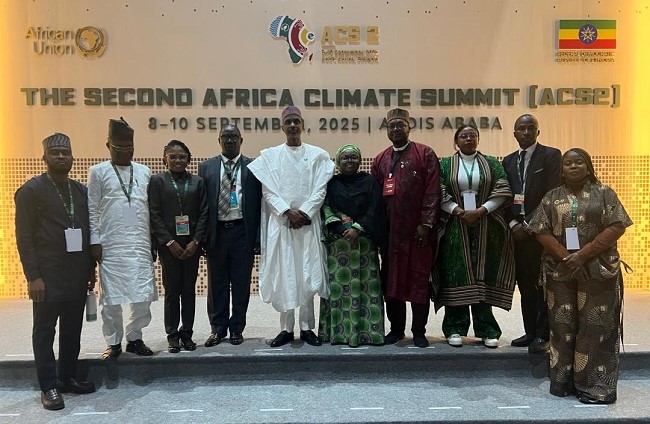
According to him, Nigeria recognises the resilience of several communities across Africa, which continue to face the most severe consequences of climate change despite contributing the least to global emissions. He noted this as a significant issue that Nigeria will address in collaboration with other nations.
The PS listed some key efforts that the government of the country has demonstrated to prove its commitment to combating the climate crisis, which include the Climate Change Act 2021, the development of an inclusive Nationally Determined Contribution (NDC) 3.0, and a framework for reporting yearly achievements.
Furthermore, while speaking on what Nigeria has done regarding its energy sector, he hinted that the nation was fast-tracking gas-to-power projects while scaling up solar and wind initiatives under its “Mission 300” agenda.
“Pilot projects on green and blue hydrogen, as well as utility-scale energy storage, were being deployed to improve grid reliability,” he stated.
Climate-smart agriculture programmes to reach millions of smallholder farmers and expansion of flood control measures and resilient housing are some other key areas of interventions. Additionally, some other are a nationwide rollout of clean cookstoves and LPG cylinders aimed at reducing household air pollution by 60% by 2030.
Yusuf said in terms of climate finance, Nigeria planned to mobilise significant funds in the next five years, with at least 40 per cent directed to adaptation and resilience for the most vulnerable and front-line communities.
He disclosed that the nation would rely on public-private partnerships, blended finance, green bonds, and carbon markets to scale climate solutions.
“Nigeria is determined to partner with all member states, institutions, and donors,” he said, “to translate climate ambition into concrete, scalable, and impactful action, as envisaged in the African Union Agenda 2063.”
Finally, the head of the Nigerian delegation urged African countries to increase access to technology, improve regional power sharing, and use green guarantees to reduce the risk of climate investments.
By Etta Michael Bisong, Abuja