

On Sunday, July 27, 2025, the EU and U.S. struck a framework agreement that imposes a 15% tariff on most EU goods entering America. In exchange, the EU has committed to purchase $750 billion in U.S. energy, including liquefied natural gas (LNG).
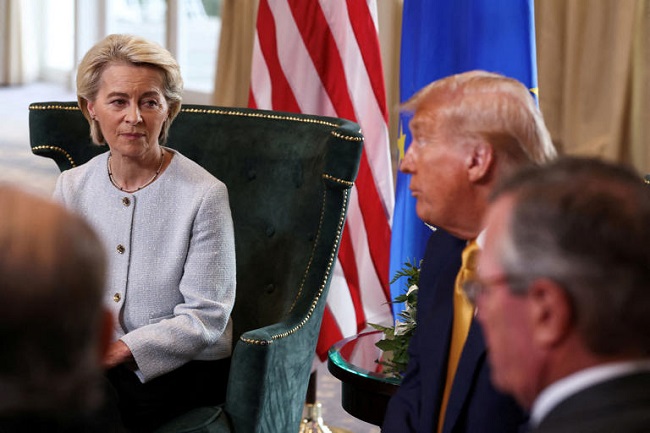
In addition, President Donald Trump of the US said the EU would invest $600 billion in the US and buy military equipment worth “hundreds of billions of dollars”.
European Commission President, Ursula von der Leyen, confirmed that the EU would seek to buy an extra $250 billion of US energy products each year from now until 2027.
“With this deal, we are securing access to our largest export market,” she said.
At the same time, she acknowledged that the 15 percent tariffs would be “a challenge for some” European industries.
Inn a reaction, Andreas Sieber, Associate Director of Policy and Campaigns at 350.org, said: “It’s deeply shortsighted to see the EU strike a so-called ‘deal’ with the U.S. that locks us into expensive, polluting gas. Fossil gas is not only worse for the climate than coal, but it also comes at a higher cost. This risks locking Europe into decades of fossil fuel dependence, volatile energy bills, and accelerating the wildfires and flooding already wreaking havoc across the continent. While Trump celebrates this as a win, communities on both sides of the Atlantic are suffering with deadly climate impacts.
“European country governments and EU Commissioners must reject importing more LNG and fossil fuels from the United States. At this critical juncture for climate action, and as we await an updated climate target from the EU, we must accelerate a just transition away from fossil fuels and a full pivot to clean, affordable, renewable energy.”
According to observers, the United States has continued to flood Europe with fossil fuels, cementing LNG and fossil fuel dependency accounting for over 50% of Europe’s LNG supplies in Q1 of 2025, while contributing virtually nothing to the EU’s clean technology imports. According to official EU statistics, this is a lopsided trade that locks Europe deeper into fossil dependence.
LNG is not a bridge to decarbonisation, it is a super-polluter:
- U.S. LNG produced from fracked gas has a 33% higher lifecycle emissions footprint than coal.
- Over a 20 year timeframe, methane is at least 80 times more potent than CO2 as a climate pollutant. As such, LNG may represent the most climate-damaging fossil fuel currently in use.
- In 2024, the European Union sourced a staggering 90% of its gas from abroad, a dependence that leaves the bloc dangerously exposed to foreign suppliers, price volatility, and geopolitical blackmail, undermining any claim to true energy security. Deepening dependence on U.S. fossil fuels is a strategic misstep that leaves Europe exposed to price shocks and supply disruptions. Relying on massive LNG imports not only locks in higher and more volatile energy costs but also undermines Europe’s long-term energy security and sovereignty.
- LNG-fired power remains up to three times more expensive than renewable energy in many regions. Even with a looming global glut that may push prices down, LNG is set to stay uncompetitive – locked into high costs and outpaced by cheaper, cleaner energy alternatives.
The EU must show real leadership and reject any deal that ties our future to fossil gas. 350.org calls on EU decision-makers to:
- Commit to a 1.5°C aligned climate plan, with an updated and ambitious NDC and 2040 climate goal.
- Accelerate investment in clean, renewable energy and modern grids to ensure affordability and resilience.
- Cancel new LNG terminals and long term contracts that risk becoming stranded assets and legal liabilities.
French Prime Minister, Francois Bayrou, called the deal a “dark day” for Europe, saying the bloc had caved in to the US president with an unbalanced deal that spares US imports from any immediate European retaliation.
“It is a dark day when an alliance of free peoples, brought together to affirm their common values and to defend their common interests, resigns itself to submission,” Bayrou wrote on X of what he called the “von der Leyen-Trump deal”.
Wolfgang Niedermark, a board member of the Federation of German Industries trade body, called the deal “an inadequate compromise” with the EU “accepting painful tariffs”.
A 15 percent tariff rate “will have a huge negative impact on Germany’s export-oriented industry”, he said.
Benjamin Haddad, France’s European affairs minister, said: “The trade agreement … will bring temporary stability to economic actors threatened by the escalation of American tariffs, but it is unbalanced.”
Echoing that sentiment, Dutch Foreign Trade Minister, Hanneke Boerma, said the deal was “not ideal” and called on the commission to continue negotiations with Washington.